Fortress of Verisimilitude
There is something loaded about military architecture long after its purpose has faded.
Take the pillbox — an oddly domestic name for a brutal concept: cast concrete, thick walls, a slit window. Just enough vision to watch the world without exposure. The geometry deflects. The psychology stays hyper-vigilant.
A pillbox doesn't just protect its occupants; it edits the world. It narrows what can be seen until only a sliver of reality remains. Everything else is left unseen, but there.
Architecture often works this way. Walls divide space, determine what stays hidden, decide how light enters a room and how a body moves through it. Buildings structure how we occupy reality.
We inherit rooms we didn't build: family histories, inherited assumptions, small injuries that coalesce into habits of perception. Eventually it's hard to tell where experience ends and the architecture begins.
Bitterness works the same way. Disappointment leads to caution. Caution becomes preference. Preference hardens into reflex. Eventually the walls feel permanent. What interests me isn't bitterness itself, but its relationship to certainty. Defensive positions promise clarity through seclusion. But that clarity is bought by narrowing what you can perceive. Every fortification carries a self-inflicted blindness.
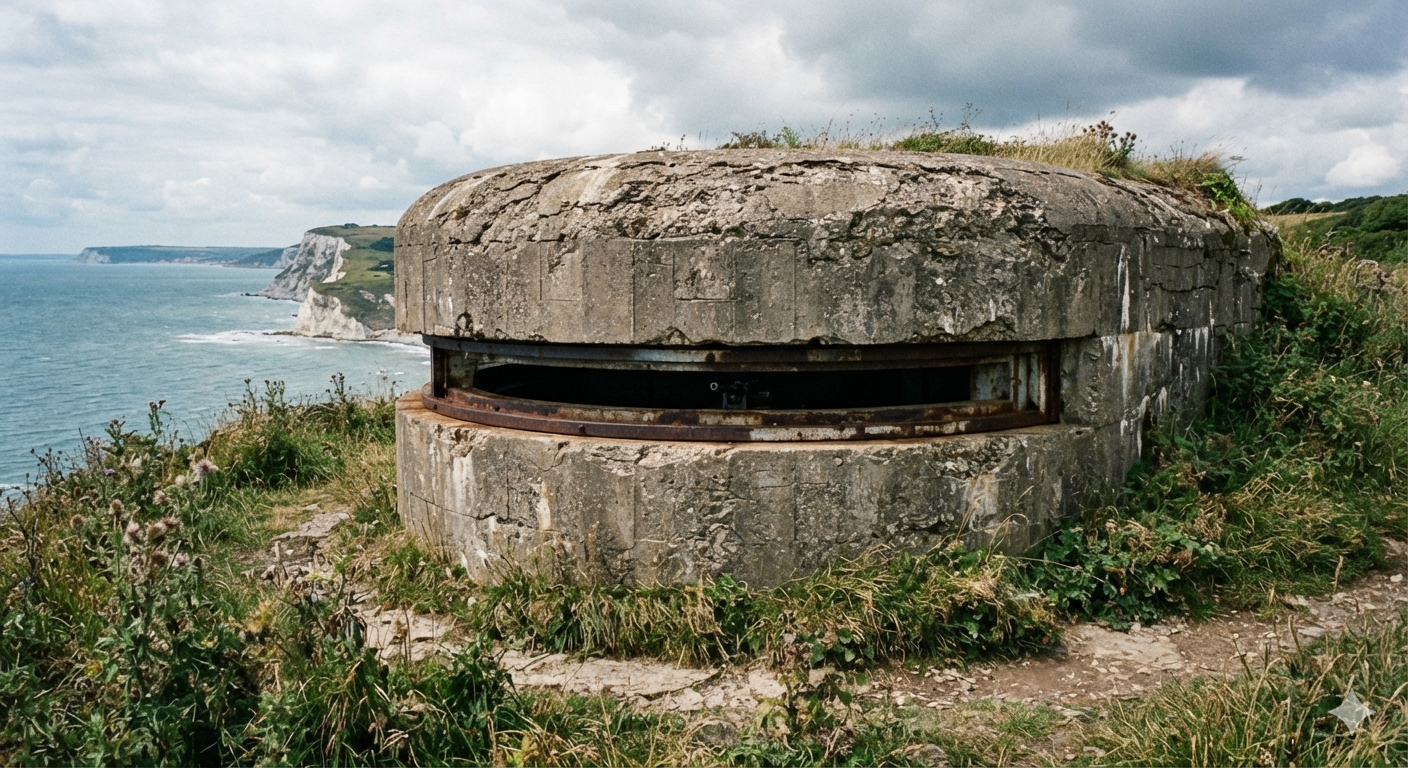
A German pillbox overlooking the English Channel.
The military pillbox watches an uncertain horizon. It is organized less around conflict than anticipation. Its real occupant is the unknown. So many spaces we inhabit now are built for seclusion rather than encounter: curated, filtered, prioritizing confirmation over curiosity. Protection and withdrawal start to look identical. Which one you're seeing may just depend on which side of the wall you're standing on.
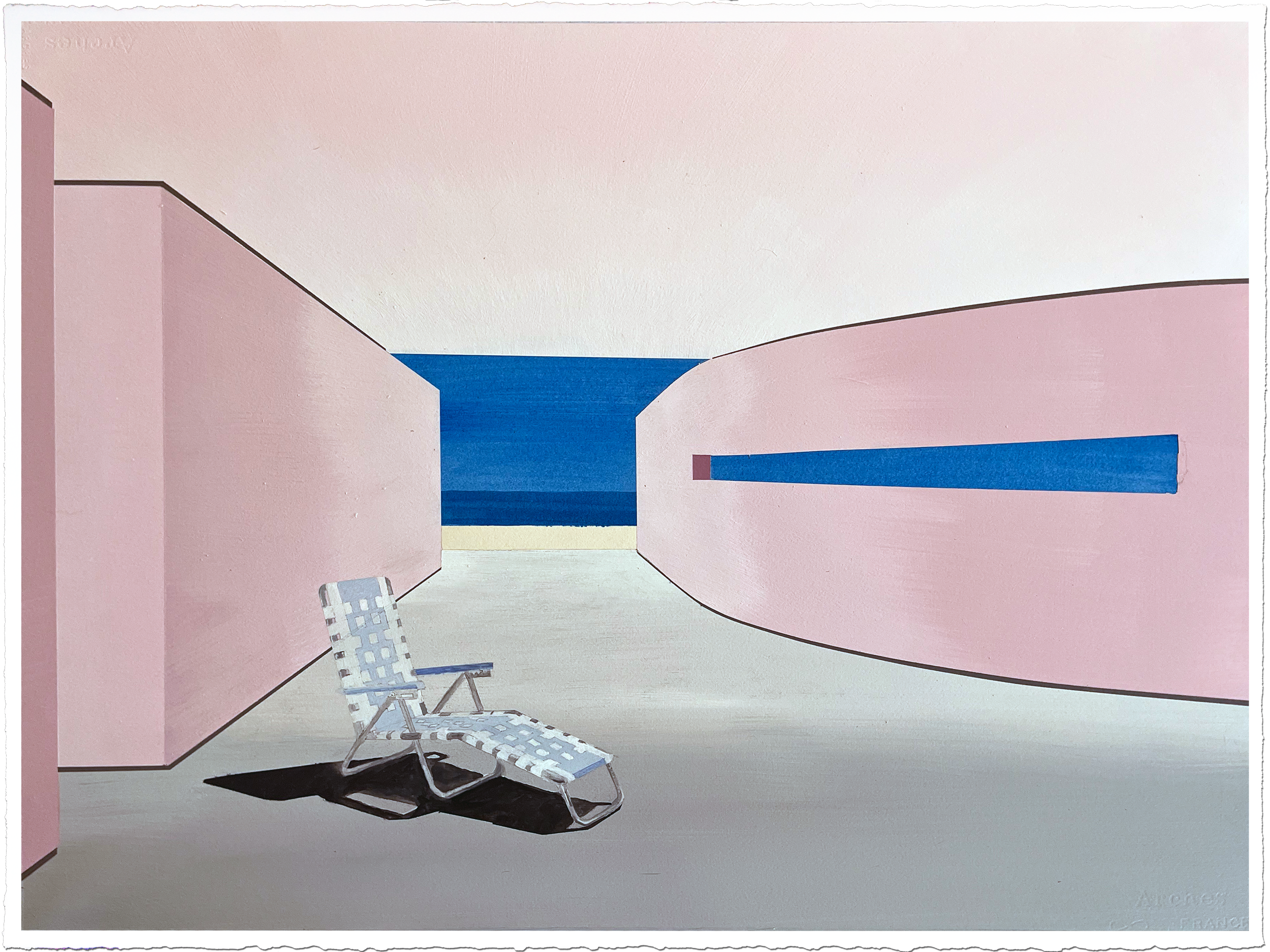
BITTER PILLBOX. 2026. Watercolor, gouache, acrylic, graphite & ink on paper. 22.5 × 30 inches.
For Bitter Pillbox, I hijacked the visual language of resort architecture — places built for the exact opposite purpose. Curved pink walls. Warm colors. A cheap aluminum lawn chair carries the lazy memory of suburban patios and summer afternoons. Nothing announces danger. That's the contradiction the painting runs on: architecture promising one feeling while quietly preparing you for another. Somewhere in the process I noticed I'd quietly inverted the architecture — the exterior of the pillbox had become the interior of the room. The slit that once let a soldier see out now lets the viewer see through: the same aperture, turned inside out.
That inversion runs through the whole piece. The room refuses to cohere — brightly lit with no visible source, while the horizon outside stays flat and unreadable. The shadows don't agree with each other; they belong to different systems of logic. At first glance it looks ordinary. Only after lingering does the logic start to waver.
Paintings can hallucinate without turning surreal. Familiarity itself can turn odd.
I'm drawn to spaces that feel psychologically true rather than optically correct — rooms that obey the logic of memory over physics, where recognition arrives slowly, in stages.
There are no figures because none are needed. The room is already occupied — not by a person, but by a condition. Even the furniture is caught in the same inversion as the architecture: reinforced concrete imagines permanence; the aluminum chaise accepts impermanence without protest. History reverses that bet anyway. The bunker remains standing long after the certainty that built it has dissolved. The chair was never meant to last. The bunker was never meant not to.
Maybe rooms remember us. Or maybe they just reveal the shapes our habits have already taken.
A hard truth is called a bitter pill. A pillbox exists to postpone that reckoning for as long as possible: the pill must be swallowed, the pillbox demands you wait. The hardest truths aren't out past the horizon. They're already built into the architecture we've mistaken for ourselves.
Bitter Pillbox is on view in Collective Renderings of We the People at Da Vinci Art Alliance, July 1–19.