So, How Did That Make You Feel?
Every painting begins with a pressure. Not an idea, not a message, certainly not a position — more often a feeling of lack, or disturbance, or resignation. Something unresolved looking for somewhere to exist. My first response isn't to write, or sketch, or think harder.
I build a room.
The rooms always come first — empty stages, theatrical black boxes to work things out, empty enough to breathe and wait in. I trust architecture more than I trust ideas. That's something I gleaned from Donald Judd, probably: a rectangle, a wall, a window, a table. Simple forms have always felt honest to me. Before anything strange can happen, the room has to establish a baseline of trust, and sometimes I'll cycle through thirty or forty interiors before one's proportions feel inevitable. I don't fully know why one works and another doesn't. I just trust it when it does.
Everything after that is lipstick.
Then the furniture arrives. Then the objects, one by one, auditioning for the room. Some stay. Most don't. Eventually the room starts making demands of its own, and I usually don't understand the logic of those demands until long after the painting is finished.
Latency arrived no differently.
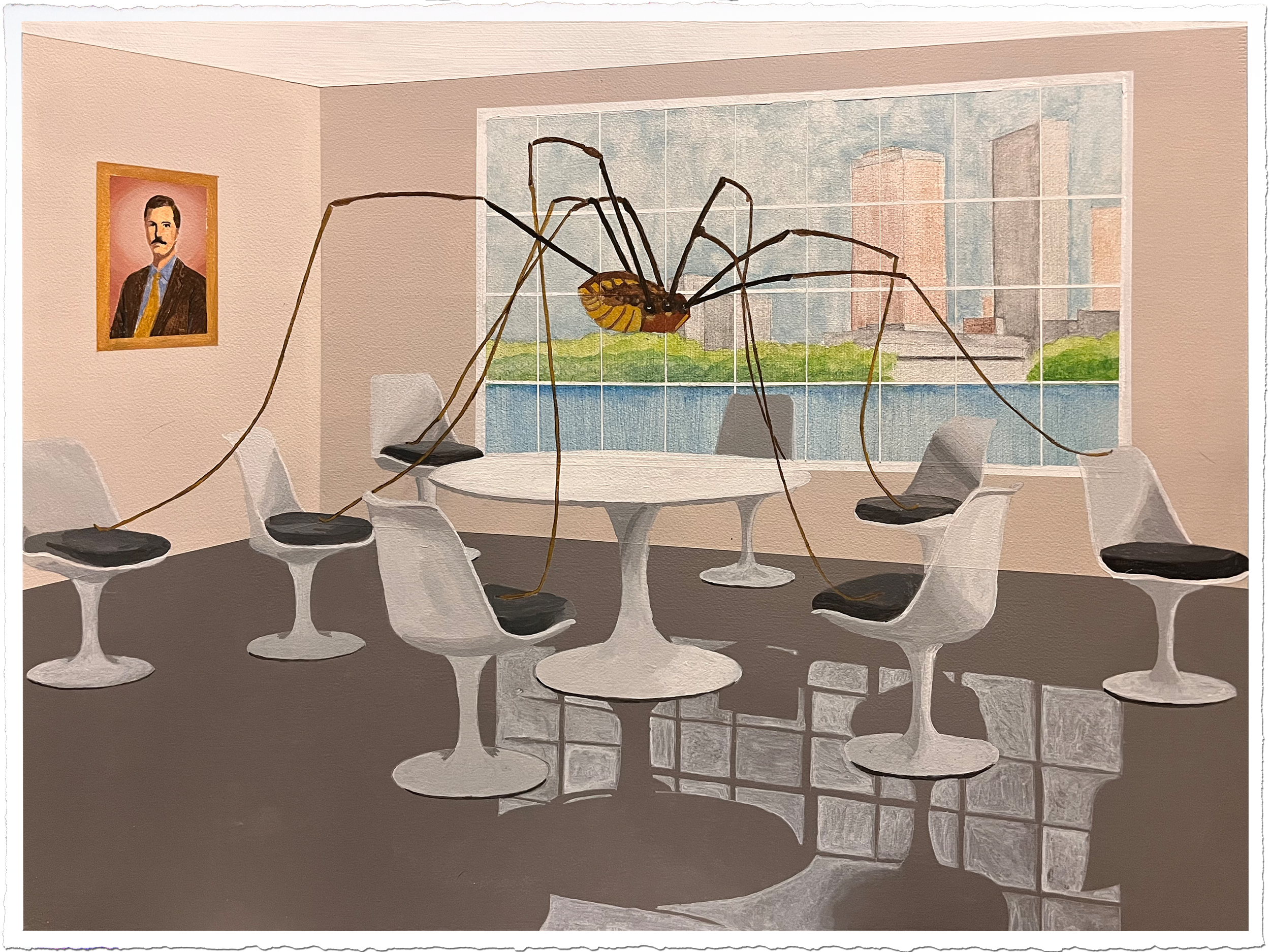
LATENCY. 2026. Watercolor, gouache, acrylic, graphite & ink on paper. 22.5 × 30 inches.
It began as a room. The architecture suggested a Saarinen dining set. But the creature I eventually introduced had eight legs, and eight chairs made sense in a way a domestic table no longer did — so the furniture morphed, and the dining room quietly became a boardroom.
Only much later did I realize it wasn't really a boardroom. It was a laboratory. Or maybe it had always been one.
The difference matters. A containment room assumes something dangerous escaped. A laboratory acknowledges that it was created there.
People ask whether the arachnid is about artificial intelligence, and I understand why — it brushes against the same conversations: authorship, consolidation, autonomy, and systems whose operations increasingly exceed ordinary human comprehension. But the painting isn't trying to make an argument about AI any more than it's trying to make an argument about politics. My paintings aren't built for that kind of specificity. They aren't position papers or agitprop. Painting is a poor medium for policy. It’s better at atmosphere. Friction. The emotional residue after the fact.
Anxiety is living in the future. That's the territory Latency occupies.
Nothing appears to be happening. No alarms sound, no one is running. The chairs sit patiently around the table, each touched by one of the creature's eight legs. A room full of decision makers has already become something else entirely. The arachnid doesn't hunt. It consolidates.
Viewers inevitably bring up other spiders: Louise Bourgeois' monumental Maman, the impossible arachnids drifting over Toronto in Denis Villeneuve's Enemy. Those associations don't bother me — they're part of the cultural weather now — but they aren't quite this creature. Bourgeois' spider is maternal. Mine is apex. Mine consolidates.
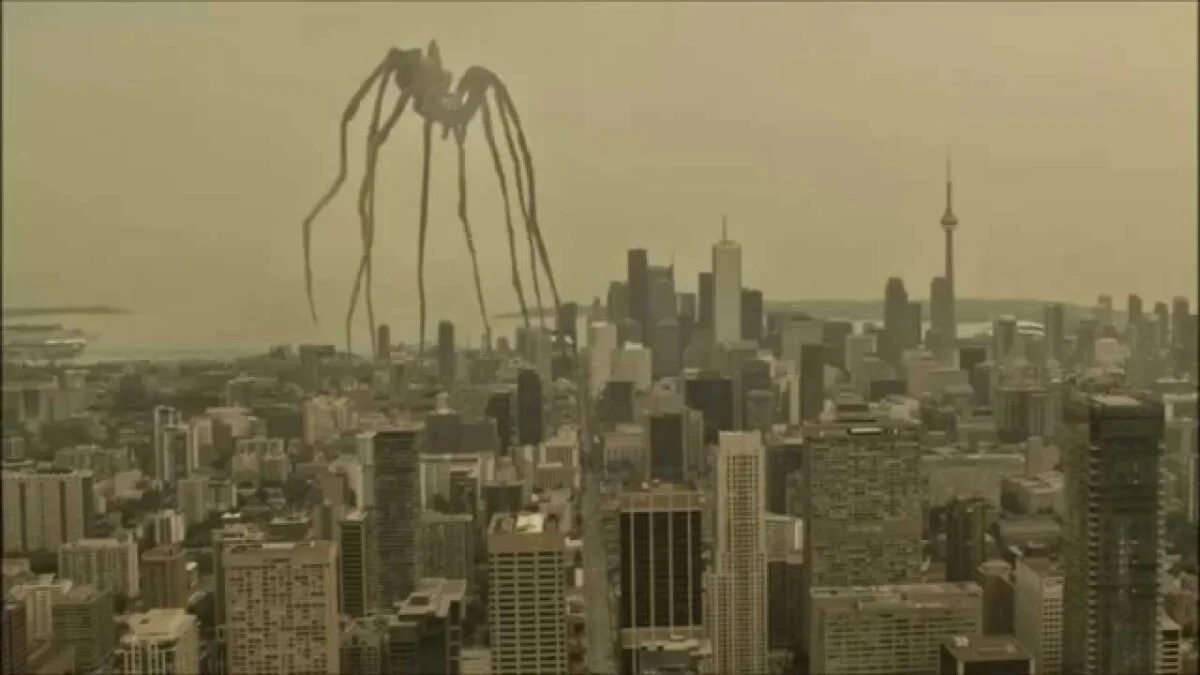
Film still from Enemy (2013), directed by Denis Villeneuve.
There's a fear running beneath a lot of our contemporary conversations — not just about artificial intelligence, but about institutions, automation, markets, bureaucracy, biology, technology. The fear of replacement by something we no longer fully comprehend, not because it's evil, but because it's indifferent. Presiding over the consolidation from his picture frame is the firm's highly regarded nobody, who doesn't know yet. Or does, and simply isn't asked.
I'm not sure that's what the painting means. But it's where the room led me, and the connections, as always, came later.
Latency is on view in Collective Renderings of We the People at Da Vinci Art Alliance, July 1–19.